Archives
-
Law and Technology: New Paradigms for the Twenty-First Century
Vol. 1 No. 1 (June 2026)Issue DescriptionThe issue, "Law and Technology: New Paradigms for the Twenty-First Century," examines the evolving relationship between legal systems and technological innovation in an increasingly digitalized world. Rapid advancements in artificial intelligence, data-driven governance, digital platforms, cybersecurity, and emerging technologies have generated complex legal, regulatory, and ethical questions that demand critical scholarly engagement.
The contributions featured in this issue explore contemporary developments at the intersection of law, technology, and public policy. Through doctrinal, analytical, comparative, and interdisciplinary approaches, the authors address significant challenges relating to digital governance, regulatory adaptation, technological accountability, privacy and data protection, intellectual property, and the broader implications of technological transformation for legal institutions.
By bringing together diverse perspectives, this issue seeks to contribute to ongoing academic discourse concerning the capacity of legal frameworks to respond effectively to technological change while preserving the foundational values of justice, accountability, human rights, and the rule of law. The articles collectively highlight the opportunities and challenges presented by emerging technologies and underscore the importance of developing responsive and future-oriented legal frameworks for the twenty-first century.
The Journal of Emerging Technology and Law remains committed to fostering rigorous scholarship and promoting interdisciplinary research that advances understanding of the legal dimensions of technological innovation and societal transformation.
-
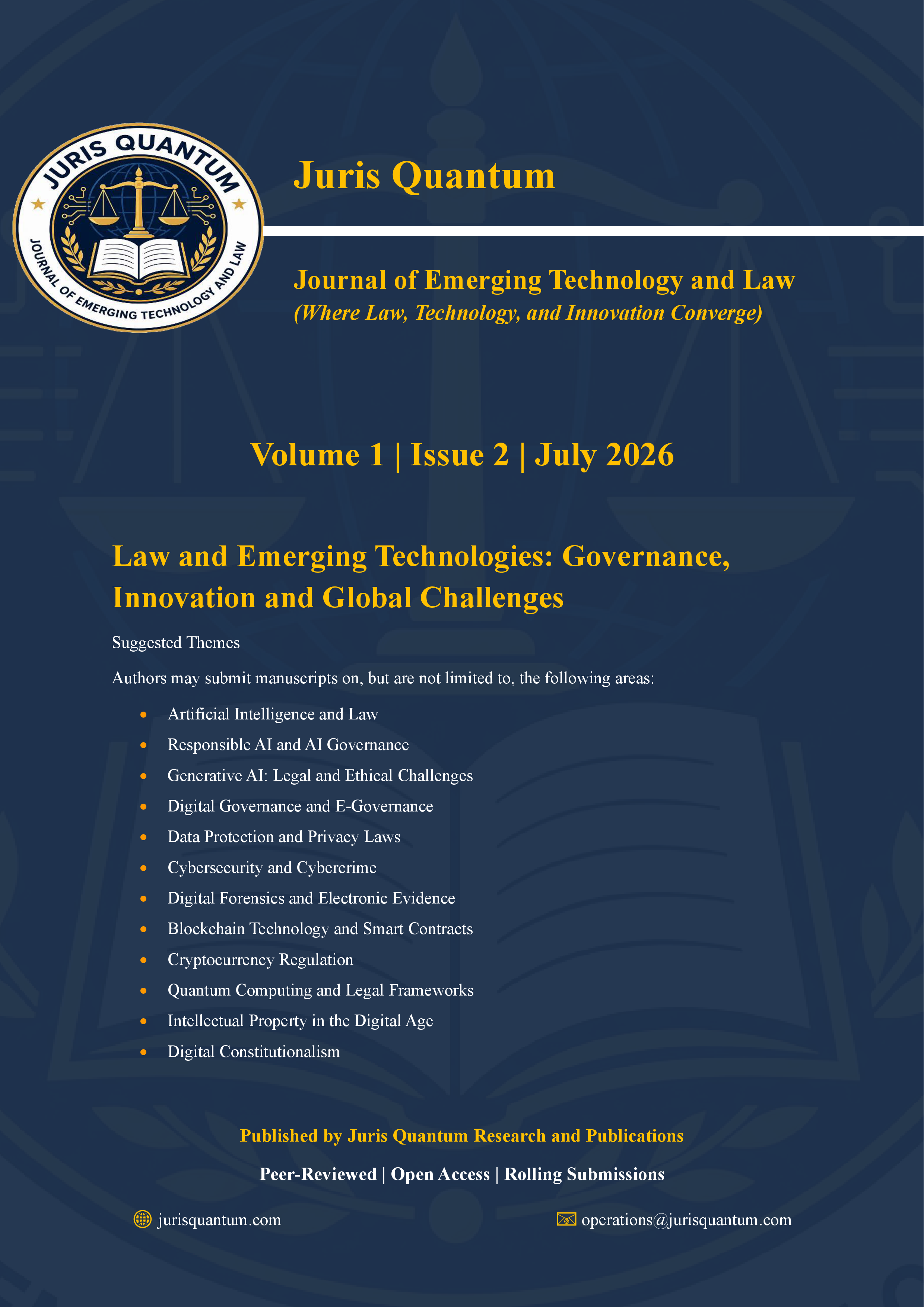
Law and Emerging Technologies: Governance, Innovation and Global Challenges
Vol. 1 No. 2 (December 2026)About the IssueThe rapid evolution of emerging technologies is reshaping legal systems, governance structures, public institutions, commercial practices, and human rights across the globe. Artificial Intelligence, blockchain, quantum computing, cybersecurity, digital finance, the Internet of Things (IoT), and data-driven technologies are creating unprecedented opportunities while simultaneously presenting complex legal and regulatory challenges.
Volume 1, Issue 2 of the Juris Quantum – Journal of Emerging Technology and Law invites original research that critically examines the interaction between law and emerging technologies from national, comparative, and international perspectives. The issue seeks interdisciplinary scholarship that contributes to contemporary legal debates, policy development, regulatory innovation, and technological governance.
Submissions may be doctrinal, empirical, comparative, interdisciplinary, policy-oriented, or case-study based. The Editorial Board particularly welcomes manuscripts that provide innovative legal solutions to emerging technological challenges while maintaining rigorous academic standards.
Suggested ThemesAuthors may submit manuscripts on, but are not limited to, the following areas:
- Artificial Intelligence and Law
- Responsible AI and AI Governance
- Generative AI: Legal and Ethical Challenges
- Digital Governance and E-Governance
- Data Protection and Privacy Laws
- Cybersecurity and Cybercrime
- Digital Forensics and Electronic Evidence
- Blockchain Technology and Smart Contracts
- Cryptocurrency Regulation
- Quantum Computing and Legal Frameworks
- Intellectual Property in the Digital Age
- Digital Constitutionalism
- Human Rights in the Digital Environment
- Platform Regulation and Social Media Governance
- Online Dispute Resolution
- FinTech and Financial Regulation
- Legal Technology (LegalTech)
- Artificial Intelligence in Judicial Systems
- Autonomous Systems and Liability
- Consumer Protection in Digital Markets
- Internet Governance
- Cross-border Data Governance
- Cloud Computing and Legal Compliance
- Internet of Things (IoT) Regulation
- Digital Health and Medical Technologies
- ESG, Sustainability and Technology Law
- Climate Technologies and Environmental Governance
- Smart Cities and Urban Governance
- Digital Labour and Platform Economy
- Comparative Technology Law
- International Technology Regulation
The Editorial Board of Juris Quantum – Journal of Emerging Technology and Law is pleased to invite high-quality original manuscripts for Volume 1, Issue 2 (December 2026).
Researchers, academicians, legal practitioners, judges, policymakers, industry experts, and doctoral scholars are encouraged to submit original and unpublished manuscripts that advance scholarly understanding of the legal dimensions of emerging technologies.
All submissions will undergo a rigorous double-blind peer-review process to ensure academic excellence and publication quality.
Who Can Submit?Submissions are invited from:
- Academicians
- Researchers
- Law Faculty Members
- Judges and Judicial Officers
- Advocates and Legal Practitioners
- Policymakers
- Industry Professionals
- Ph.D. Scholars
- LL.M. Scholars
- Interdisciplinary Researchers
The Journal welcomes:
- Original Research Articles
- Review Articles
- Case Commentaries
- Legislative Commentaries
- Comparative Legal Studies
- Policy Papers
- Short Communications
- Book Reviews
Authors are requested to ensure that:
- The manuscript is original and unpublished.
- The submission is not under consideration elsewhere.
- Proper citations and references are provided.
- AI-assisted writing, if used, is appropriately disclosed in accordance with the journal's publication ethics.
- All manuscripts conform to the journal's formatting guidelines